
Scaling Responsible AI Solutions (SRAIS) | 2024 Global Cohort

Description and Context
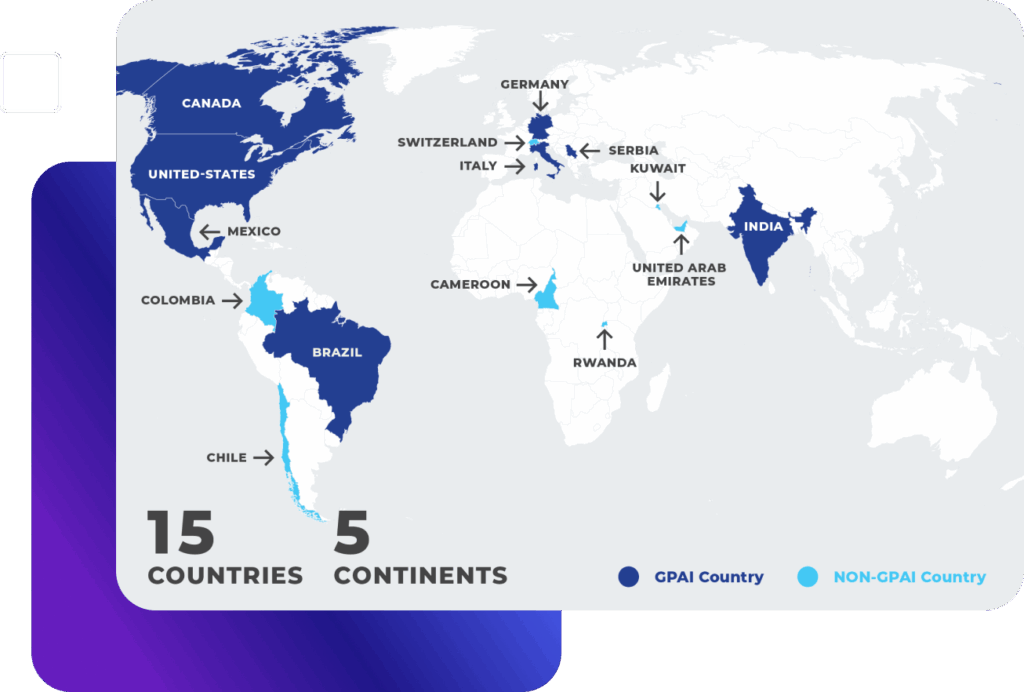
The 2024 SRAIS cycle marked the second year of a growing global initiative led by GPAI and CEIMIA, This year, the project expanded its scope and consolidated its methodology, supporting 21 AI teams worldwide in addressing the challenges that arise when responsible principles meet the realities of scaling and challenges such as data governance, cultural integration, regulatory compliance, interoperability, and the broader social, economic, and environmental impacts of AI systems.
Through a structured mentorship program, SRAIS 2024 paired innovators with expert mentors to identify priority obstacles and develop actionable strategies, while also producing insights and recommendations that extend beyond individual teams. By combining tailored guidance with knowledge-sharing, this year’s cycle advanced the creation of an international community of practice dedicated to scaling AI responsibly, strengthening both the credibility and competitiveness of responsible approaches in global markets.

Partners

Global Partnership on AI (GPAI)
The Global Partnership on Artificial Intelligence (GPAI) is an integrated partnership that brings together OECD members and GPAI countries to advance an ambitious agenda for implementing human-centric, safe, secure and trustworthy artificial intelligence (AI) embodied in the principles of the OECD Recommendation on AI.

International Center of Expertise In Montreal on Artificial Intelligence (CEIMIA)
CEIMIA is positioned as a key player in the responsible development of artificial intelligence, based on the principles of ethics, human rights, inclusion, diversity, innovation and economic growth. CEMIA delivers high-impact projects in responsible AI through influential scientific diplomacy on an international scale.
Objectives
SRAIS aims to support AI innovators worldwide in scaling their solutions responsibly; to provide hands-on mentorship that bridges the gap between Responsible AI principles and real-world deployment.
This strategic vision extends beyond individual projects, with the aim of consolidating a global community of practice dedicated to responsible and scalable AI.
Through this collaborative effort, our goal is to create an enriching exchange of knowledge and best practices, strengthening both the credibility and competitiveness of responsible AI approaches on the global stage.
Highlights and Takeaways
In 2024, the second edition of the GPAI SRAIS project, sponsored by CEIMIA and the Global Partnership on AI, attracted participants from around the world to its mentorship program. During the latter year, the project has grown in scope and impact, and has taken strides towards consolidating a global network of
collaboration and knowledge-sharing, with the creation of an independent and complementary SRAIS track in Africa. Teams and experts from Poland emerged as a particularly invested community of AI practitioners, demonstrating a strong dedication to responsible AI.
The Orange Innovation Poland team earned “Responsible AI Changemaker” recognition for their innovative work on two projects: a “traceability solution” that balances privacy with continuous improvement in product personalization, and a document outlining the uses, objectives, and “rules of engagement” for a satisfaction recognition system that enhances virtual agent interactions.
The broader discussions between experts and teams allowed to generate more insights that are useful for the advancement or the practice of responsible AI.
Scaling responsibly is complex
It is not enough to embed RAI principles at the design stage: responsibility must be maintained across the full lifecycle, from conceptualization to global deployment.
Long-term lens needed
AI systems must be assessed not only for immediate risks (bias, privacy, safety) but also for their broader social, economic, and developmental impacts, including effects on human rights, livelihoods, and sustainability.
Responsibility cannot be automated
Technical fixes are essential, but true responsibility requires ongoing dialogue, collaboration, and shared governance across stakeholders.
Trade-offs are interconnected
Efforts to improve fairness, privacy, or robustness in one area may create new challenges in data governance, labour practices, or environmental impact.
Need for stronger RAI literacy
Developers, regulators, and users often lack nuanced understanding of responsible AI principles. Mentorship and knowledge-sharing, as demonstrated by SRAIS, are critical to building capacity and embedding responsibility in scaling practices.
Participating Teams

ASLAC (Automatic Sign Language Avatar Creation) – Migam.ai (Poland)
Description
Cloud-based sign-language translation service using AI/avatars to expand accessibility for deaf and hard-of-hearing users globally.
Summary of RAI progress
Developed a framework for responsible acquisition and management of video-based training data, ensuring privacy of data subjects and compliance with intellectual property. Designed a “Data Clean Room” to depersonalize sensitive training data.
Jalisco Diabetic Retinopathy Detection & Referral (Mexico)
Description
AI-driven predictive tool to detect diabetic retinopathy and support referrals in clinical settings, developed with Jalisco State Government.
Summary of RAI progress
Worked on aligning outputs with local clinical needs, creating secure long-term strategies for data sharing/storage, and ensuring integration into medical workflows. Emphasized transparency, explainability, and environmental impact.
Personality AI – Orange Innovation Poland
Description
Hyper-personalization system based on the OCEAN framework, running locally on users’ devices without transmitting personal data externally.
Summary of RAI progress
Created a “traceability solution” and a “Privacy Guardian” dashboard to keep personalization relevant while protecting privacy and ensuring informed consent.
PredictGAD – ICGEB (Inde)
Description
AI model supporting glaucoma diagnostics by analyzing ASOCT scans to detect angle dysgenesis.
Summary of RAI progress
Expanded dataset diversity to reduce demographic bias, ensured explainability, and explored frameworks for patient data privacy and follow-up mechanisms.
Employee Performance Management, Learning & Development (Poland)
Description
AI platform for employee development, training, and performance management.
Summary of RAI progress
Focused on transparency and clarity so users understand how tasks, recommendations, and rewards are generated—whether by managers or the system.
Knowledge Chat – Websensa (Poland)
Description
LLM-based assistant enabling organizations to query internal knowledge bases.
Summary of RAI progress
Developed comprehensive, audience-specific guidelines to mitigate hallucinations and ensure transparency, data security, and explainability.
Satisfaction Recognition in AI Conversations (Poland)
Description
AI system for measuring and recognizing user satisfaction in interactions.
Summary of RAI progress
Defined objectives, safe-use guidelines, and responsibility frameworks to prevent manipulation, inaccuracies, or disruptions in user experience.
Responsible AI Co-worker – AgentAnalytics.AI (India)
Description
Multi-agent LLM orchestration platform providing “AI co-workers” for SMEs, monitored by RAI oversight agents.
Summary of RAI progress
Focused on fairness in multi-agent orchestration and preventing privacy leaks, while defining how responsibility scales with flexible use cases.